• Skip to main content
  • Skip to footer
Warner Foundation
  • Home
  • About
    • History
    • Jack & Susan Warner
  • Artwork
  • Grants & Awards
  • Newsletter
  • Media
  • Education
  • Contact
Warner Foundation

Warner Foundation

  • Home
  • About
    • History
    • Jack & Susan Warner
  • Artwork
  • Grants & Awards
  • Newsletter
  • Media
  • Education
  • Contact

Educational Resources

Colonial Wedding

“Colonial Wedding,” c. 1911
Oil on Canvas
29 1/4 x 60 1/2 inches

http://warnerfoundation.org/wp-content/uploads/2019/01/108_Henry-Edward-Lamson._COLONIAL_WEDDINGaif.mp3

Click above to hear Jack Warner’s audio on this painting.

History in the Painting by Greg Balan

lesson-planning-solid-icon-calendar-260nw-2079722362 - Edited (1)

Lesson Plan for Colonial Wedding

The Signing of the Declaration of Independence

“The Signing of the Declaration of Independence,” 1840
Oil on Canvas
47 1/2 x 74 inches

http://warnerfoundation.org/wp-content/uploads/2019/01/118_HicksEdward_DECLARATION_OF_INDEPENDENCE.mp3

Click above to hear Jack Warner’s audio on this painting.


Click here for insight into the development of the Declaration of Independence prepared by history teacher Greg Balan.

George Washington & Christopher Gist Crossing the Allegheny River

“George Washington & Christopher Gist Crossing the Allegheny River,” 1841
Oil on Canvas
 20 x 24 inches


http://warnerfoundation.org/wp-content/uploads/2019/01/124_Huntington-Daniel_WASHINGTON__CHRISTOPHER_GIST.mp3

Click above to hear Jack Warner’s audio on this painting.

Today, we present the painting “Washington and Gist Crossing the Allegheny River” by Daniel Huntington. This painting relates to the Colonial Period, specifically to the years leading up to the French and Indian War. It relates to U.S. History Standards, including the Colonial Period, the French and Indian War, Western Expansion, and the early life of George Washington. We have also invited Gregory Balan, a history teacher at Riverdale High School in Fort Meyers, Florida, to contribute a lesson plan and additional historical research specifically designed to utilize this painting in an inquiry-based approach to teaching. 

lesson-planning-solid-icon-calendar-260nw-2079722362 - Edited (1)

Lesson Plan

greg-balan

Historical Overview of Washington & Gist by History Teacher Greg Balan

About the Artist: 

Daniel Huntington was born in 1816 in New York City.  A prolific artist with over 1,200 known works, he is known mostly for his portraits, although he did paint some Hudson River-inspired landscapes and illustrations. Huntington’s paternal grandfather was Benjamin Huntington, a delegate at the Second Continental Congress and the first U.S. Representative from Connecticut. His mother was Faith Trumbull, a relative of the accomplished artist John Trumbull, and it was in his studio that young Daniel was first exposed to the genre of history painting.

Daniel studied at Yale in 1832 and Hamilton College in 1833 where he met portrait artist C.L. Elliott. In 1835 he studied at New York University with Samuel F.B. Morse (1791-1872) and later with portraitist Henry Inman (1801-1846). Huntington first exhibited his work at the National Academy of Design in 1836 and was then elected a member.

From 1839-1840 Huntington went on a grand tour of Europe, visiting England, Rome, Florence, and Paris, and became greatly influenced by the work of Renaissance painter, Titian. After his return to New York, he devoted his time chiefly to portrait-painting, although he painted many genres, religious and historical subjects, as well as landscapes in the tradition of the Hudson River School.  n 1840 he became widely recognized with the exhibition of his “Mercy’s Dream,” with an established reputation, Huntington returned to Europe again from 1851 to 1858, painting portraits of notable figures in England and elsewhere. 

In 1850 Huntington exhibited 130 of his completed York’s Art Union buildings. He personally wrote and published the accompanying catalogue. The work listed as No 91, was entered into the catalog as a “sketch for illustration” as it was the original completed painting of Washington and Gist crossing the Allegheny River which was intended to be the basis for a later engraving. This painting was also exhibited at the Pennsylvania Academy of Fine Arts in 1843 and again in 1860, where it was titled “Washington Crossing the Monongahela”.  

Davnel Huntington became one of the leading portrait artists of New York society in the post-Civil War period and a leading figure in the city’s art circle. He was president of the National Academy of Design 1862-1870, and again 1877-1890. He was also vice president of the Metropolitan Museum of Art. He died in 1906.

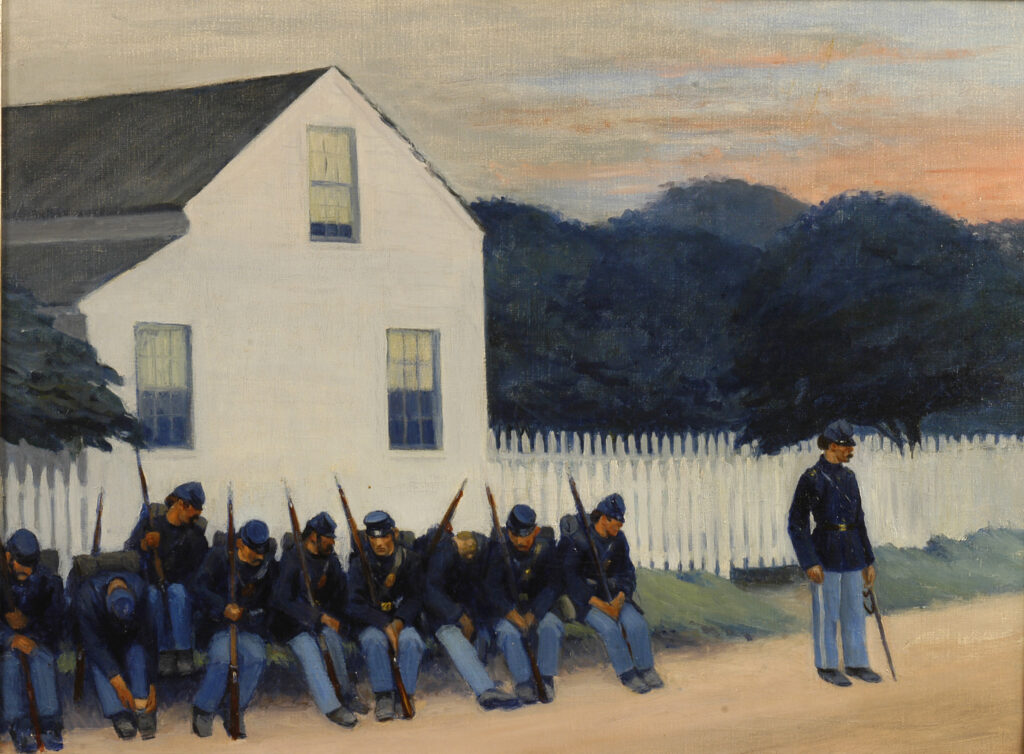
Dawn Before Gettysburg

“Dawn Before Gettysburg,” 1934
Oil on Canvas
15 x 20 inches

We are developing materials to assist K-12 American History and Social Studies teachers to utilize great works of art from the former Warner Collection available on this website to better teach U.S. History in the classroom. Each month, we will feature a new painting and provide historical information that will help teachers utilize the image to teach visual literacy skills while engaging students in conversation and critical thinking about important themes in American History. These lesson plans will help teachers integrate the study of History with the study of art. We will also be inviting a current teacher to contribute additional historical information that can be used to enrich the lesson plan.

History in the Painting by Greg Ballan

lesson-planning-solid-icon-calendar-260nw-2079722362 - Edited (1)

Lesson Plan for “Dawn Before Gettysburg”

history icon

More Information about Edward Hopper’s Civil War Paintings

Catskill Mountain House

Property of Warner Foundation
“Catskill Mountain House,” c.1846
Oil on Canvas
 24 x 32 1/2 inches

The Catskill mountain House was executed in 1846, almost certainly the last of several images that Cole had painted of his historic destination. Opened in 1824, Catskill Mountain House was situated on a high palisade overlooking the Hudson River and attracted the elite of American society in the early years of the nineteen century. In Cole’s painting, the Mountain House towers over the landscape like a temple in the wilderness, with its thirteen colossal Corinthian columns rendered in particular detail. Cole paints himself at the base of the Mountain. The landscape, although partially tamed by the Mountain House, retains a strong sense of the wilderness that enamored Cole throughout his career. This painting remained until the 1950s in the family of Mr. Charles Beach, the proprietor.

  Click here to read the historical context of the painting prepared by History Teacher Greg Balan

Click here for a lesson plan focusing on Expansion and Industrial Transition in Antebellum American Society, using Catskill Mountain House for historical context.

Footer

  • Home
  • About
    • History
    • Jack & Susan Warner
  • Artwork
  • Grants & Awards
  • Newsletter
  • Media
  • Education
  • Contact

© 2026 Warner Foundation. All rights reserved.